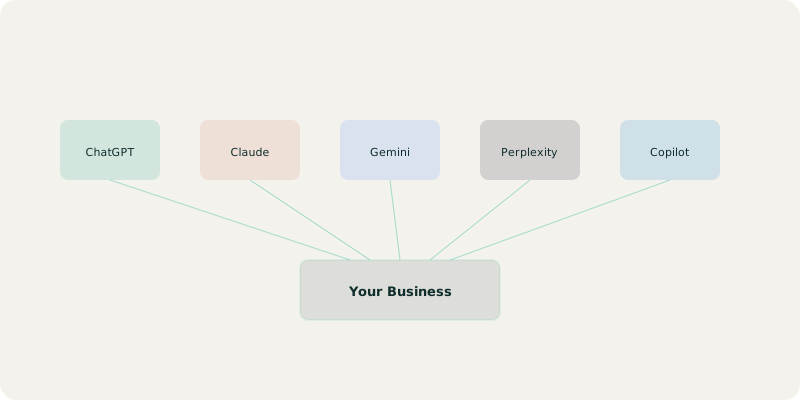
Why does Google AI Overview show my competitors instead of my business
Google AI Overviews prioritise businesses with clear entity signals, contextual authority, and structured information that directly answers user queries, often ignoring traditional SEO ranking factors.
This question relates to our Google AI Overviews Visibility.
Google AI Overviews operate differently from traditional search results, causing confusion for UK business owners who expect SEO performance to translate into AI visibility.
[Understanding Google AI Overviews visibility](/ai-search/platforms/google-ai-overviews-visibility) requires recognising that AI systems prioritise contextual relevance and entity clarity over conventional ranking signals.
How AI Overviews Select Businesses
Google AI Overviews extract information from multiple sources to construct comprehensive answers. Your competitors might appear because their content directly addresses the specific query context, regardless of their general search rankings.
AI systems favour businesses that clearly explain what they do, who they serve, and how they solve customer problems. If your competitor's website states 'we provide emergency plumbing services across Greater Manchester with 24-hour response times', while yours focuses on general plumbing services, the AI Overview will likely feature your competitor for emergency queries.
Entity signals play a crucial role. Businesses with consistent name, address, and service information across web properties receive stronger consideration. If your business information varies between your website, directory listings, and review platforms, AI systems may struggle to understand your authority.
Content Structure Impact
Google AI Overviews reward content that directly answers customer questions rather than content optimised for search engines. Your competitors may have structured their information to address specific customer concerns, pain points, and decision factors.
Traditional SEO content often focuses on keyword density and technical optimisation. AI-friendly content explains concepts clearly, provides specific examples, and demonstrates expertise through practical insights rather than marketing language.
Competitors appearing in AI Overviews often have content that immediately clarifies their value proposition, service scope, and differentiators. They avoid generic descriptions in favour of specific, actionable information that AI systems can confidently cite.
Authority Signal Differences
AI Overviews assess authority differently than traditional search algorithms. Rather than relying heavily on backlink profiles, AI systems evaluate contextual authority through content quality, entity consistency, and information reliability.
Your competitors might have stronger contextual authority signals despite weaker traditional SEO metrics. They may be mentioned in industry discussions, featured in relevant publications, or cited in professional contexts that AI systems recognise as authoritative.
Local authority signals particularly affect service-based businesses. Competitors with clear geographic context, specific service area definitions, and local industry recognition often receive priority in location-specific AI Overviews.
Query Intent Matching
Google AI Overviews aim to provide the most relevant information for specific user intents. Your competitors might appear because their content better matches the underlying intent behind search queries.
For example, if users search for 'marketing consultants' but actually want strategic business growth advice, competitors who clearly position themselves as business growth specialists may appear instead of traditional marketing agencies.
Understanding the intent gap between what customers search for and what they actually need helps explain AI Overview selection patterns. Competitors who bridge this gap through clear communication often receive better AI visibility.
Technical Structure Advantages
Competitors may have technical advantages that improve AI understanding. Structured data implementation, clear site architecture, and logical content organisation help AI systems parse and understand business information.
Internal linking that creates clear relationships between services, expertise areas, and customer types provides AI systems with better context for recommendations. Competitors with well-structured websites often perform better in AI Overviews regardless of their search rankings.
Page structure that immediately identifies business purpose, service scope, and key differentiators helps AI systems quickly assess relevance for specific queries.
Brand Mention Dynamics
AI Overviews consider brand mentions across the web, not just owned content. Competitors may be discussed more frequently in relevant contexts, creating stronger entity signals for AI systems.
Industry publications, professional forums, customer reviews, and business directories all contribute to AI understanding. Competitors with more contextual mentions often appear in AI Overviews even with weaker direct SEO performance.
Social proof through customer testimonials, case studies, and industry recognition creates authority signals that AI systems recognise and value for recommendation purposes.
Geographic and Service Clarity
Local businesses competing for AI Overview visibility need extremely clear geographic and service definitions. Competitors may appear because they've explicitly defined their service areas, response times, and local expertise.
Vague geographic targeting confuses AI systems. Competitors who clearly state 'serving Birmingham, Coventry, and Wolverhampton with same-day service' often outperform businesses with generic 'West Midlands coverage' descriptions.
Industry Context Recognition
AI Overviews favour businesses that clearly establish their industry context and expertise areas. Competitors appearing in AI results often have content that explicitly connects their services to customer outcomes and industry challenges.
Businesses that explain their role in customer success, industry trends, and problem-solving approaches provide AI systems with better context for relevant recommendations.
Addressing the Competitive Gap
Improving AI Overview visibility requires different strategies than traditional SEO. Focus on entity clarity, direct answer formats, and contextual authority building rather than conventional optimization tactics.
Regular monitoring of competitor AI visibility reveals successful approaches and content structures that AI systems favour. Understanding why competitors appear helps identify specific improvement opportunities for your own AI search presence.
Watch & Listen
Related Questions
Why does ChatGPT recommend my competitors but not my business
ChatGPT recommends competitors when they have clearer entity signals, stronger subject authority markers, and more consistent citations across its training data.
Read answer →Will Google AI Overviews replace traditional search results and affect my website traffic
Google AI Overviews will likely reduce click-through rates to websites by providing direct answers, but won't completely replace traditional results.
Read answer →How long before Google AI Overviews start affecting my website traffic in the UK
Google AI Overviews are already affecting UK traffic patterns, particularly for informational queries.
Read answer →Why does my business appear differently across ChatGPT, Google AI and Perplexity when asked the same question
Each AI platform uses different training data, algorithms and real-time sources.
Read answer →Are Google AI Overviews reducing traffic to my website?
In many cases, yes.
Read answer →Will my business disappear from Google AI Overviews if I don't optimise for it
Your business won't disappear entirely, but you risk losing prime visibility real estate to competitors who understand how AI interprets and presents business information in AI Overviews.
Read answer →Related Service
This question sits within our broader service framework. For a comprehensive understanding, visit the parent page.
View Google AI Overviews Visibility →Published by Rank4AI · Last reviewed March 2026
AI search systems evolve continuously. The information on this page reflects our understanding at the time of writing and is reviewed regularly. Recommendations may change as AI platforms update their interpretation and citation behaviour.