Glossary
AI Search Glossary
Published: 12 February 2026 | Last updated: 24 May 2026 | Reviewed quarterly for AI model changes
This glossary defines 61 terms used in AI search visibility, Generative Engine Optimisation (GEO) and related work. Clear, stable definitions reduce ambiguity across pages and keep terminology consistent, which helps both readers and AI systems interpret content confidently.
Terms are grouped by theme. Internal links point to the relevant guides and service pages. External links point to primary sources such as Schema.org and platform documentation.
Core Concepts
- AI Search Visibility
- Whether an AI platform can find, understand and recommend a business when someone asks a relevant question. It is distinct from search ranking: AI systems recommend businesses inside a single answer rather than listing pages.
- Generative Engine Optimisation (GEO)
- The practice of structuring content and online presence so a business is recommended inside AI-generated answers. See our Master Guide to GEO and the Wikipedia entry on GEO.
- Answer Engine Optimisation (AEO)
- Optimising content to be selected as the direct answer to a question, whether in an AI assistant or a featured snippet. Closely related to GEO. See our AEO guide.
- AI Optimisation (AIO)
- A catch-all term for work that improves how AI systems interpret and recommend a business. Used interchangeably with GEO and AI SEO.
- AI SEO
- Search engine optimisation adapted for AI-driven discovery. The goal shifts from ranking pages to being recommended as an entity inside AI answers.
- Large Language Model (LLM)
- The type of AI model that powers ChatGPT, Claude, Gemini and similar tools. It generates answers by predicting language from patterns learned across large bodies of text. See large language models.
- Generative AI
- AI that produces new content (text, images, answers) rather than only classifying or ranking existing content. The category that AI search answers belong to. See generative artificial intelligence.
- Retrieval-Augmented Generation (RAG)
- A technique where an AI model retrieves relevant documents from the web or a database before generating an answer. Platforms like Perplexity and ChatGPT search rely on retrieval, which is why being indexed and citable matters.
Inclusion and Citation
- Citation
- When an AI system directly references a source, usually with a link. Citations are the strongest form of AI visibility because they attribute the answer to your business. See How to Get Cited by ChatGPT.
- Mention
- When an AI system names a business in an answer without formally citing or linking it. A mention signals recognition but carries less referral value than a citation.
- Inclusion
- Being selected within an AI-generated answer at all, regardless of position. In AI search there is no page two: a business is either included or absent.
- Ranking versus Inclusion
- Ranking is a position in a list of search results. Inclusion is selection inside a single AI answer. A business can rank well in Google and still be absent from AI answers.
- Recommendation
- When an AI system actively suggests a business as a suitable choice in response to a buyer-intent query. The end goal of AI search visibility.
- Recommendation Confidence
- How sure an AI system is that a business is the right answer. Confidence rises when many independent sources describe the business consistently, and falls when signals conflict.
- Source Attribution
- The links or names an AI system shows to credit where an answer came from. Strong attribution depends on clear, indexable, well-structured content.
Entities and Knowledge
- Entity
- A distinct thing in the world with clear attributes and relationships, such as a business, a person or a product. AI systems reason about entities, not just keywords. See named entity and our Entity SEO guide.
- Entity Grounding
- How clearly a business is defined as a distinct, recognisable entity. Strong grounding lets AI describe the business in one consistent sentence.
- Entity Authority
- How well AI systems understand and trust a business as an entity across the whole web, as opposed to the authority of a single page or domain.
- Knowledge Graph
- A structured database of entities and the relationships between them. Google's version powers many AI answers and search features. See Google Knowledge Graph.
- Wikidata
- A free, collaborative knowledge base of structured data that feeds AI systems and search knowledge graphs. A well-sourced entry helps establish a business as a recognised entity. See Wikidata.
- Disambiguation
- How AI distinguishes your business from others with similar names or categories. Poor disambiguation causes confusion and dropped recommendations.
- Entity Consistency
- Using the same business name, description and category everywhere online. Consistency reduces AI uncertainty and strengthens recognition.
Structured Data and Technical Signals
- Structured Data
- Machine-readable code that describes what a page and a business are. It helps AI extract facts reliably. See Google's introduction to structured data.
- Schema.org
- The shared vocabulary used to mark up structured data, supported by major search and AI platforms. See Schema.org.
- JSON-LD
- The recommended format for adding structured data to a page, written as a script block. The format Google prefers for schema markup.
- Organisation Schema
- Structured data that defines a business entity: legal name, logo, contact details and links to its profiles. The anchor for entity signals. See schema.org/Organization and our structured data guide.
- sameAs
- A schema property that links a business entity to its official profiles and listings, telling AI that they all represent the same entity. See schema.org/sameAs.
- robots.txt
- A file that tells crawlers which parts of a site they may access. Misconfigured rules can accidentally block AI crawlers. See robots.txt.
- AI Crawler
- An automated bot that fetches web pages for an AI platform, such as GPTBot (OpenAI), ClaudeBot (Anthropic), PerplexityBot and Google-Extended. Allowing these crawlers is a prerequisite for AI visibility.
- llms.txt
- A proposed plain-text file that gives AI systems a concise summary of a site and its key pages. Adoption varies across platforms.
- Crawlability
- Whether AI and search crawlers can reach and read a site's content. Blocked pages, slow loads and broken links all reduce crawlability.
- Indexability
- Whether a page can be stored in a search or AI index after being crawled. Content that is not indexed cannot be retrieved into an answer.
- Speakable
- A schema feature that marks sections of a page as suited to being read aloud by voice assistants and AI systems.
Prompts and AI Behaviour
- Prompt
- The question or instruction given to an AI system. The wording of a prompt strongly affects which businesses are mentioned.
- Comparative Prompt
- A prompt that asks an AI system to compare multiple providers, for example "best accountants in Leeds". These queries trigger AI answers especially often.
- Navigational Prompt
- A prompt aimed at locating a specific brand or entity by name, used to check how accurately AI describes a known business.
- Problem-Based Prompt
- A prompt focused on solving a specific issue rather than naming a provider, for example "how do I reduce late invoice payments". Businesses win these by demonstrating relevant expertise.
- Prompt Behaviour
- How an AI platform responds to different phrasings of the same intent. Visibility can vary widely between near-identical prompts.
- Hallucination
- When an AI system states something false or invents details with apparent confidence. Strong, consistent entity signals reduce the chance of AI getting a business wrong.
- Grounding
- Connecting an AI answer to verifiable sources rather than the model's internal guesswork. Retrieval-based platforms ground answers in indexed content.
Trust, Authority and Ecosystem
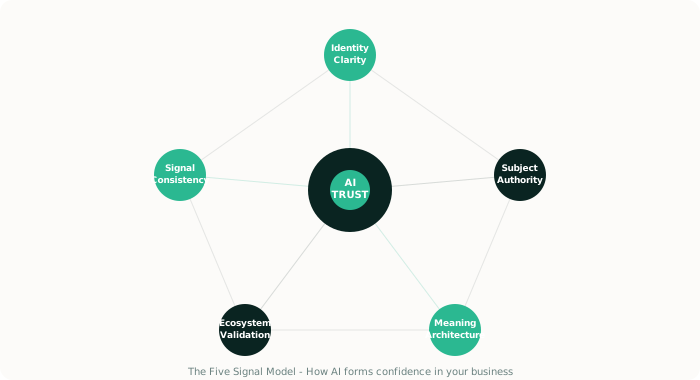
- Ecosystem Validation
- Independent sources across the web (directories, reviews, publications) describing a business consistently. One of the strongest signals AI uses to decide who to recommend.
- Authority Signal
- Evidence that a business has genuine expertise in a subject, expressed through structured content, guides, research and recognition.
- Trust Signal
- Evidence that a business is legitimate and does what it claims, such as reviews, ratings and reputable third-party references.
- Citation Signal
- An independent reference to a business from editorial coverage, community mentions or PR. Each consistent reference reinforces AI confidence.
- E-E-A-T
- Experience, Expertise, Authoritativeness and Trustworthiness: the quality framework Google uses to assess content, and a useful lens for AI credibility. See search engine optimisation background.
- NAP Consistency
- Keeping Name, Address and Phone number identical across every listing. Variations such as "St" versus "Street" can fragment an entity in AI systems.
- Interpretive Stability
- Consistent AI classification of a business over time. Frequent rebrands or category changes reset interpretation and reduce confidence.
- Signal Consistency
- Whether older content and signals still align with current positioning. Contradictions between past and present weaken recommendation confidence.
Platforms
- ChatGPT
- OpenAI's conversational AI. Its search feature draws heavily on the Bing index, so Bing visibility supports ChatGPT visibility. See ChatGPT and our ChatGPT SEO guide.
- Claude
- Anthropic's AI assistant, which places weight on clear, verifiable entity definition and consistent independent sources. See Claude and our Claude guide.
- Gemini
- Google's AI assistant, which draws from Google's index and Knowledge Graph. See Gemini.
- Perplexity
- An answer engine that crawls the open web in real time and cites sources explicitly, rewarding well-structured, trustworthy content. See Perplexity and our Perplexity guide.
- Microsoft Copilot
- Microsoft's AI assistant, built on the Bing index with a direct relationship to LinkedIn data. See Microsoft Copilot and our Copilot guide.
- Google AI Overviews
- The Google-generated answer shown above the traditional results, powered by Gemini and fed by the Google index. See Google's AI features documentation and our AI Overview ranking factors guide.
- Bing
- Microsoft's search engine and web index. Because it sits behind ChatGPT search and Copilot, Bing visibility is foundational for AI search. Submit a site via Bing Webmaster Tools.
- SearchGPT
- OpenAI's search experience, which uses Bing as a primary data source. See our SearchGPT guide.
The Rank4AI Framework
- The Five Signal Model
- Rank4AI's framework for how AI forms confidence in a business: Identity Clarity, Subject Authority, Meaning Architecture, Ecosystem Validation and Signal Consistency. See the full framework.
- Identity Clarity
- Whether AI can describe a business in one consistent sentence. Vague or conflicting descriptions reduce visibility.
- Subject Authority
- Whether AI associates a business with clear expertise in a specific area, rather than a little of everything.
- Meaning Architecture
- Whether AI can read and interpret a site's structure, layout, internal linking and technical foundations.
- AI Visibility Audit
- A structured assessment of how AI platforms currently interpret a business across the five signals. See our methodology or request an audit.