How does AI marketing growth differ from traditional digital marketing?
Updated 31 March 2026
Quick Answer
AI marketing growth focuses on how AI platforms interpret and recommend your brand, not just how search engines index your pages. Traditional digital.
Watch on YouTube: How does AI marketing growth differ from traditional digital marketing?
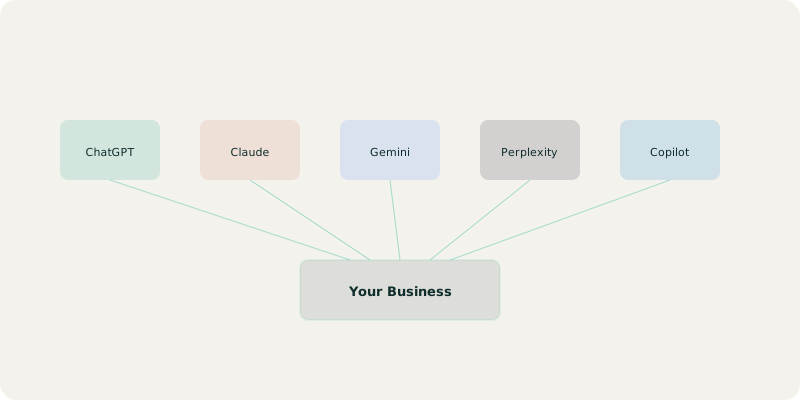
Traditional digital marketing has always revolved around a simple loop: create content, optimise for search engines, drive clicks, measure conversions. AI marketing growth breaks that loop entirely. Instead of optimising for where your link appears in a list of ten blue results, you are optimising for whether AI platforms like ChatGPT, Google Gemini, Perplexity, and Claude include your brand in their generated responses.
This distinction matters because AI platforms do not rank pages - they synthesise answers. When someone asks ChatGPT "which UK agencies help with AI visibility?", the model draws from structured data, entity clarity, and signal consistency to decide which brands to mention. Traditional SEO metrics like keyword density and backlink volume play a diminished role in this context.
At Rank4AI, we approach AI marketing growth through the Five Signal Model: Identity Clarity, Subject Authority, Meaning Architecture, Ecosystem Validation, and Signal Consistency. Each signal addresses a different dimension of how AI systems understand your brand. Traditional marketing typically addresses only one of these - subject authority through content - while ignoring the structural and ecosystem signals that AI platforms weight heavily.
Another key difference is measurement. In traditional digital marketing, you track rankings, click-through rates, and bounce rates. In AI marketing growth, you track citation frequency, answer inclusion across platforms, entity accuracy, and recommendation likelihood. These are fundamentally different metrics that require different tools and frameworks.
The shift is not optional. As AI platforms capture an increasing share of search behaviour - Gartner projects 25% of searches will be AI-mediated by late 2026 - brands that only optimise for traditional search will find themselves progressively excluded from the conversations that matter most.
Why this matters for UK businesses
AI search is changing how customers find businesses. When someone asks ChatGPT, Claude, Gemini, Perplexity, Copilot or Google AI a question like this, the platform gives a direct answer. It does not show a list of links.
The business that AI understands and trusts gets named. The rest are invisible. In our testing of 1,400+ UK businesses, 77% are sending confusing signals to AI platforms.
Understanding questions like this one is the first step to making sure AI recommends your business, not your competitors. Get a free AI visibility audit to see where you stand.
Related
Adam Parker
AI Search Visibility Specialist
Adam is the founder of Rank4AI, specialising in AI search visibility. He helps businesses get found across ChatGPT, Gemini, Perplexity, and AI Overviews through technical optimisation and strategic content.
Last reviewed: Invalid Date