Research / Study
The UK AI Visibility Audit 2026
By Adam Parker, Founder of Rank4AI. Published 14 July 2026. A first-party study of 1,400+ UK business websites.
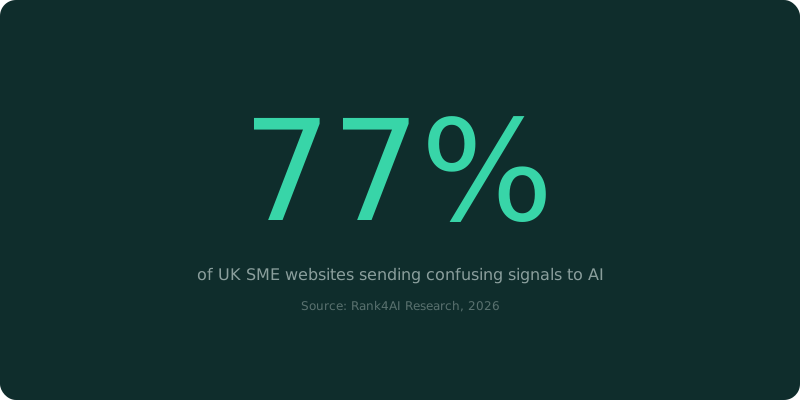
Most UK business websites are not yet readable by AI search platforms. In Rank4AI structured audits of 1,400+ UK business websites in 2026, 77% send conflicting signals to AI platforms, 62% describe the business differently across their title, H1 and meta description, 44% have no organisation schema, 23% block at least one major AI crawler, and only 4% use Person schema to connect a named individual to the business. This study sets out the methodology behind those figures, the Five Signal Model used to measure them, and the full set of findings.
Methodology
The study draws on Rank4AI's AI Search Visibility Audit: a 17-section structured assessment run across five signal layers. It tests how AI platforms currently interpret a business, not how they should. It does not manipulate AI systems: it observes what AI platforms can currently find, read and understand about a business, and identifies where interpretation is incomplete, inconsistent or absent.
UK business websites audited
structured audit sections per site
AI platforms tested: ChatGPT, Claude, Gemini, Perplexity, Copilot, Google AI
Sample
The sample is 1,400+ UK business websites audited by Rank4AI in 2026. The findings below are diagnostic signals, not a national census: treat them as directional patterns across audited UK SME websites rather than fixed national rates. Each figure is the share of audited sites showing that signal.
What we measured: the Five Signal Model
Every site is assessed across five signal layers. Together they describe whether an AI platform can identify a business, judge its authority, read its meaning, corroborate it externally, and trust that its signals agree.
Identity Clarity, Whether AI platforms can resolve who the business is and describe it consistently.
Subject Authority, Whether the site demonstrates depth and expertise in its category.
Meaning Architecture, Whether structured data and internal structure make meaning machine-readable.
Ecosystem Validation, Whether the business is corroborated consistently across external platforms.
Signal Consistency, Whether current and historical signals agree rather than contradict.
Two scores
AI Visibility Score (weighted)
A weighted score reflecting the relative importance of each signal layer for a specific business category.
Structural Reference Score (unweighted)
An unweighted score showing raw signal completeness across all 17 sections.
The full method, including limitations, is documented at /research/methodology/.
Key findings
Each figure is the share of audited UK business websites showing that signal.
of UK SME websites are sending confusing signals to AI search platforms
have homepage alt text issues
have no copyright year in their footer
describe their business differently across title, H1 and meta description
have unclear H1 headings
have FAQ content but no FAQ schema
have no sameAs social links in structured data
have no organisation schema
have all three trust pages (privacy, terms, cookies)
have severe title tag and H1 misalignment
are blocking at least one major AI crawler
of review claims are unverifiable
have an llms.txt file
have Person schema
| Finding | Value |
|---|---|
| of UK SME websites are sending confusing signals to AI search platforms | 77% |
| have homepage alt text issues | 76% |
| have no copyright year in their footer | 67% |
| describe their business differently across title, H1 and meta description | 62% |
| have unclear H1 headings | 53% |
| have FAQ content but no FAQ schema | 52% |
| have no sameAs social links in structured data | 48% |
| have no organisation schema | 44% |
| have all three trust pages (privacy, terms, cookies) | 36% |
| have severe title tag and H1 misalignment | 29% |
| are blocking at least one major AI crawler | 23% |
| of review claims are unverifiable | 20% |
| have an llms.txt file | 13% |
| have Person schema | 4% |
Source: Rank4AI Research, 2026
Based on structured audits of 1,400+ UK business websites. Each figure is the share of audited sites showing that signal.
View as plain-text Markdown
### The UK AI Visibility Audit 2026: findings (share of audited UK business websites)

| Finding | Value |
| --- | --- |
| of UK SME websites are sending confusing signals to AI search platforms | 77% |
| have homepage alt text issues | 76% |
| have no copyright year in their footer | 67% |
| describe their business differently across title, H1 and meta description | 62% |
| have unclear H1 headings | 53% |
| have FAQ content but no FAQ schema | 52% |
| have no sameAs social links in structured data | 48% |
| have no organisation schema | 44% |
| have all three trust pages (privacy, terms, cookies) | 36% |
| have severe title tag and H1 misalignment | 29% |
| are blocking at least one major AI crawler | 23% |
| of review claims are unverifiable | 20% |
| have an llms.txt file | 13% |
| have Person schema | 4% |

Source: Rank4AI Research, 2026

Based on structured audits of 1,400+ UK business websites. Each figure is the share of audited sites showing that signal.
“These are diagnostic signals, not a ranking score. A site can have clean schema and still lose AI visibility if its core entity is described inconsistently across title, H1 and meta. The figure that worries me most is the 4% with Person schema: AI engines lean on named, verifiable authors to decide who to trust, and almost no UK business gives them anything to resolve.”
Writing about UK AI search? These figures are free to embed and cite under a Creative Commons Attribution 4.0 licence. Please credit Rank4AI and link to this study.
Related
Adam Parker
Founder, Rank4AI
Adam is the founder of Rank4AI, specialising in AI search visibility. He helps businesses get found across ChatGPT, Gemini, Perplexity, and AI Overviews through technical optimisation and strategic content.
Last reviewed: 14 July 2026
Frequently asked questions
How many UK websites were audited for this study?
The study is based on Rank4AI structured audits of 1,400+ UK business websites in 2026. Each figure quoted is the share of audited sites showing that signal.
What is the Five Signal Model?
The Five Signal Model is the framework Rank4AI uses to measure AI search visibility across five layers: Identity Clarity, Subject Authority, Meaning Architecture, Ecosystem Validation and Signal Consistency. Each site is assessed across 17 structured sections mapped to these layers.
Can I cite or reuse these figures?
Yes. The dataset is published under a Creative Commons Attribution 4.0 licence and is free to embed and cite. Please credit Rank4AI and link back to this study. Embeddable versions are available at /embeddable-data/.
Are these figures a national census of UK businesses?
No. They are diagnostic signals from audited UK business websites, not a national census. Treat them as directional patterns rather than fixed national rates.
Is your business one of them?
Get a free audit to see how AI platforms read your business across all five signal layers.
Get a Free AI Search Visibility Audit →