AI Search Visibility
Why AI Search Platforms Favour Established Brands Over UK
Quick Answer
AI search platforms favour established brands due to training data bias, where larger companies have significantly more online mentions, reviews, and citations in the datasets used to train these systems. ChatGPT, Claude, and Perplexity rely heavily on authoritative sources that naturally reference well-known brands more frequently. This creates a recommendation disadvantage for UK SMEs who lack the digital footprint density required for consistent AI platform visibility.
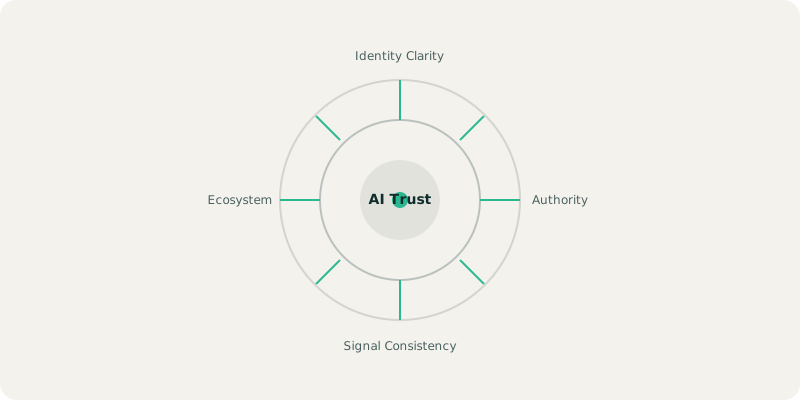
AI search platforms systematically favour established brands because their training data contains disproportionately more references to large companies, creating an inherent bias against UK small and medium enterprises seeking equal recommendation opportunities.
Published: 25 March 2026
Last Updated: 25 March 2026
The emergence of AI-driven search through platforms like ChatGPT, Claude, Gemini, and Perplexity has altered how UK businesses gain visibility. Unlike traditional search engines, these systems rely on training data patterns that inherently favour brands with extensive online presence. For UK SMEs competing against household names, understanding this AI search visibility challenge becomes critical for maintaining competitive positioning in 2026.
How Training Data Creates Brand Bias in AI Recommendations
Training datasets used by major AI platforms contain millions more references to established brands than smaller businesses, creating systematic recommendation bias that affects UK SME visibility across all AI search platforms.
The issue stems from how AI models learn about businesses during training. Large language models analyse vast amounts of text from news articles, websites, reviews, and social media posts. Established brands like Tesco, John Lewis, or BT appear in training data thousands of times more frequently than local UK businesses.
This frequency bias means when users ask ChatGPT or Claude for recommendations, the models naturally gravitate towards entities they've encountered most often during training. A Manchester accounting firm with 50 online mentions cannot compete against KPMG's thousands of references across news, case studies, and industry publications.
The training data cutoff dates compound this problem. Most AI platforms trained on data up to specific dates, missing recent UK SME developments. Your local business might have launched an award-winning service in 2024, but AI models trained on 2023 data won't know it exists.
Why Traditional SEO Cannot Fix AI Search Bias
Traditional search engine optimisation works because Google crawls websites regularly, updating rankings based on current content and authority signals. AI platforms operate differently. They generate responses from fixed training knowledge rather than real-time web searches.
Creating brilliant content today won't influence ChatGPT's recommendations tomorrow. The model's knowledge remains frozen at its training cutoff. This creates a frustrating disconnect where UK SMEs can rank highly on Google but remain invisible in AI conversations.
Some newer AI search platforms attempt real-time web integration, but they still rely heavily on pre-trained knowledge for initial response generation. The bias towards established brands persists even when supplemented with current web data.
The Impact on UK Small Business Competition
This bias creates serious competitive disadvantages for UK SMEs across multiple sectors. When consumers ask AI platforms for restaurant recommendations in Birmingham, hotel suggestions in Edinburgh, or solicitor referrals in Leeds, the responses skew towards recognisable chains and established firms.
Local businesses often provide superior service, competitive pricing, and personalised attention. However, their limited digital footprint in training data means AI platforms rarely recommend them. This perpetuates a cycle where large brands gain more visibility, leading to more online mentions, reinforcing their dominance in future AI training datasets.
The challenge extends beyond direct recommendations. AI platforms increasingly power voice assistants, business directories, and comparison sites. Poor AI search visibility affects multiple touchpoints where potential customers might discover UK SMEs.
Understanding these limitations helps UK businesses develop strategies that account for AI platform biases while building the digital presence necessary for future model training cycles.
About Rank4AI
Rank4AI is a UK AI search agency. We help businesses get recommended by ChatGPT, Claude, Gemini, Perplexity, Copilot and Google AI. We have audited over 1,400 UK businesses and published original research on AI search visibility patterns.
Every engagement starts with a free audit across all six AI platforms. Request yours here.
Related
Adam Parker
AI Search Visibility Specialist
Adam is the founder of Rank4AI, specialising in AI search visibility. He helps businesses get found across ChatGPT, Gemini, Perplexity, and AI Overviews through technical optimisation and strategic content.
Last reviewed: Invalid Date