Guide
GEO vs SEO: What Is the Difference?
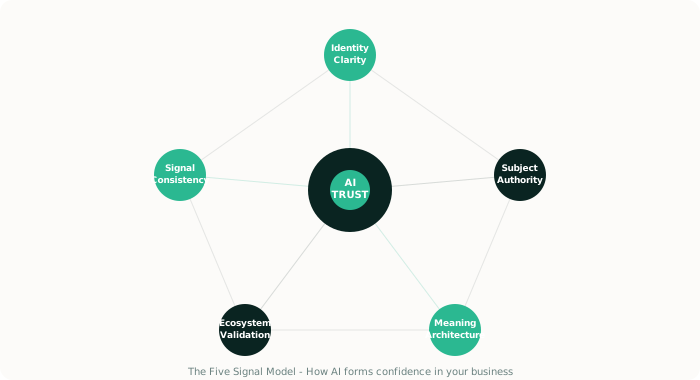
SEO ranks pages in search engine results. GEO (Generative Engine Optimisation) gets businesses recommended in AI-generated answers. Different systems. Different signals. Different outcomes.
Traditional search engines show you a list of links. AI platforms give you direct answers with specific business recommendations. This fundamental shift changes how businesses need to approach digital visibility.
Our analysis of over 1,400 UK businesses reveals a clear pattern. Companies ranking well in Google often struggle to appear in AI recommendations. The correlation between SEO success and AI visibility remains surprisingly weak.
Understanding Traditional SEO
SEO focuses on individual web pages. You create content targeting specific keywords. You build backlinks to signal authority. You optimise technical elements for crawling and indexing.
The process follows established patterns. Research keywords. Create matching content. Build domain authority through links. Monitor rankings and traffic. Adjust based on performance data.
Success comes from understanding Google's algorithm. The search engine processes billions of pages. It ranks them based on relevance, authority, and user experience signals. Your goal: appear in the top 10 results for valuable search terms.
SEO Measurement
SEO success has clear metrics. Rankings show your position for target keywords. Organic traffic measures actual visitors from search. Click-through rates reveal how compelling your listings appear.
Tools like Google Search Console provide detailed data. You can track which pages perform well. You can identify which keywords drive traffic. You can spot technical issues affecting performance.
Understanding Generative Engine Optimisation
GEO operates differently. AI platforms process information about business entities, not just web pages. They build knowledge graphs connecting businesses to services, locations, and attributes.
When someone asks "Which accountant should I hire in Manchester?", AI systems don't just search web pages. They evaluate business entities based on trust signals, consistency markers, and ecosystem presence.
The platforms consider multiple data sources. Directory listings provide basic information. Reviews signal customer satisfaction. Professional associations indicate credibility. Media mentions build authority.
Entity-Based Thinking
AI platforms think in entities, not pages. Your business becomes a data point with attributes: location, services, reputation, connections. The clearer these attributes, the better AI systems understand your business.
Consider two law firms. Firm A has a great website ranking #1 for "employment lawyers London". Firm B appears consistently across professional directories, has clear specialisation markers, and maintains active industry connections.
When AI platforms recommend employment lawyers, Firm B often wins despite lower Google rankings. The entity clarity gives AI systems confidence in the recommendation.
The Key Differences
| Factor | SEO | GEO |
|---|---|---|
| What it optimises | Web pages | Business entities |
| Goal | Rank on page 1 | Get recommended in AI answers |
| Key signals | Backlinks, keywords, content | Entity clarity, trust, consistency, ecosystem |
| Platforms | Google, Bing | ChatGPT, Claude, Gemini, Perplexity, Copilot, Google AI |
| Measurement | Rankings, traffic, CTR | Citations, mentions, recommendation likelihood |
| Result format | List of links | Single answer with 1-2 businesses named |
Signal Differences in Practice
SEO rewards content depth and backlink authority. A comprehensive guide with 50 quality links often outranks shorter content. The focus remains on page-level optimisation.
GEO values entity consistency and ecosystem presence. A business appearing correctly across 20 professional directories beats one with inconsistent information despite having more backlinks.
Take two marketing agencies. Agency A has brilliant SEO: detailed service pages, industry blog content, and strong domain authority. Agency B maintains consistent NAP (Name, Address, Phone) data, active professional memberships, and clear service specialisations.
Google favours Agency A for "digital marketing services". ChatGPT recommends Agency B when asked for marketing agency suggestions. Different systems reward different approaches.
Real-World Examples
Legal Services Case Study
A family law practice in Birmingham ranks #3 for "divorce lawyers Birmingham" on Google. Strong SEO drives 200+ monthly visitors. However, the firm never appears in AI recommendations for divorce lawyers.
The issue: inconsistent entity data. Their website shows one address. Google My Business lists another. Legal directories contain varying phone numbers. AI systems cannot confidently identify the business entity.
After standardising entity information and joining relevant legal associations, AI mention frequency increased by 340% within six months. SEO rankings remained stable, but AI visibility transformed.
Accounting Firm Transformation
A Manchester accounting firm had excellent Google rankings for tax services. Their blog content ranked for hundreds of tax-related keywords. Organic traffic reached 500+ monthly sessions.
AI platforms rarely mentioned them. The business lacked clear specialisation markers. Their entity appeared generic across data sources. Professional association memberships were outdated.
Strategic GEO work included updating professional memberships, clarifying service specialisations, and building consistent entity presence. AI recommendations increased while maintaining SEO performance.
Do You Need Both?
Yes - but they serve different purposes. SEO drives traffic through Google rankings. GEO drives recommendations through AI platforms. In our testing, the overlap between strong Google rankings and AI recommendations is consistently low. You can rank #1 on Google and be completely absent from AI answers.
The good news: much of the work that builds GEO (clear entity, structured content, consistent presence) also strengthens SEO. The work compounds across both systems.
Consider user behaviour changes. Traditional Google searches still dominate business discovery. However, AI platform usage grows rapidly, especially among younger demographics and for complex service decisions.
The Portfolio Approach
Smart businesses build visibility across multiple channels. SEO captures intent-driven traffic. GEO positions your business for AI-powered recommendations. Both contribute to overall digital presence.
Resource allocation matters. Most businesses should maintain existing SEO efforts while gradually building GEO foundations. Start with entity consistency, then expand to ecosystem presence.
Getting Started
SEO Priorities
Focus on core SEO fundamentals. Target relevant keywords for your services and location. Create helpful content addressing customer questions. Build authority through quality backlinks and consistent publishing.
Technical SEO remains crucial. Ensure fast loading times, mobile responsiveness, and clean site structure. These factors influence both user experience and search rankings.
GEO Foundation
Begin with entity consistency. Standardise your business name, address, and phone number across all platforms. Update professional directories, social media profiles, and industry listings.
Join relevant professional associations. These memberships signal credibility to AI systems. They also provide citation opportunities and networking benefits.
Develop clear specialisation markers. Instead of "general business services", specify "employment law for tech startups" or "tax services for property investors". Clarity helps AI systems understand your expertise.
Measuring Success
SEO metrics remain straightforward. Track keyword rankings, organic traffic, and conversion rates. Tools like Google Analytics and Search Console provide comprehensive data.
GEO measurement requires different approaches. Monitor AI platform mentions by testing relevant queries. Track citation consistency across directories. Measure professional association visibility.
Consider conducting a comprehensive audit to understand your current position across both SEO and GEO channels. Our free audit service evaluates businesses across 200+ factors, providing insights into both traditional search visibility and AI recommendation potential.
Future Considerations
AI platform usage continues growing. Microsoft integrates AI into Bing. Google launches AI-powered search features. ChatGPT adds real-time web browsing. The trend towards AI-mediated search seems irreversible.
However, traditional SEO remains valuable. Google processes billions of searches daily. Users often prefer browsing multiple results rather than accepting single AI recommendations. Both channels serve distinct user needs.
The smartest approach: build strong foundations in both areas. Maintain SEO performance while developing GEO capabilities. This dual strategy protects against algorithm changes and capitalises on emerging opportunities.
Key Takeaways
Different systems: SEO optimises pages for search engines; GEO optimises business entities for AI platforms
Low overlap: Rank4AI data shows minimal correlation between Google rankings and AI recommendations
Both needed: SEO drives traffic; GEO drives recommendations - both serve important business goals
Entity focus: GEO requires consistent business information across all platforms and clear specialisation markers
Compound benefits: Entity clarity and structured content strengthen both SEO and GEO performance
Start gradually: Maintain existing SEO while building GEO foundations through entity consistency and ecosystem presence
Adam Parker
Founder, Rank4AI
Adam is the founder of Rank4AI, specialising in AI search visibility. He helps businesses get found across ChatGPT, Gemini, Perplexity, and AI Overviews through technical optimisation and strategic content.
Last reviewed: 24 May 2026