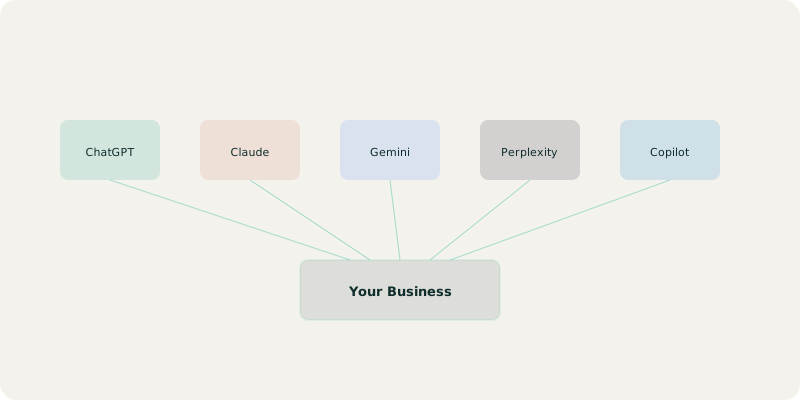
Strong Google rankings don't guarantee AI search visibility. AI systems evaluate businesses differently, focusing on meaning and context rather than.
Traditional Google ranking success doesn't translate directly to AI search visibility, creating a strategic gap many businesses overlook. Understanding the [fundamental differences between AI SEO and traditional SEO](/ai-seo-agency-uk/ai-seo-vs-seo) reveals why separate optimisation approaches are necessary.
## Different Evaluation Criteria
AI systems like ChatGPT, Claude, and Gemini evaluate businesses using criteria that differ substantially from Google's traditional ranking factors. While Google's algorithm focuses heavily on keyword relevance, authority signals, and technical optimisation, AI systems prioritise contextual understanding and meaning interpretation.
This means businesses ranking first for competitive keywords might receive zero mentions in AI recommendations if their content lacks clear semantic structure or fails to establish obvious expertise areas.
The disconnect becomes particularly apparent in competitive industries where traditional SEO success often relies on technical optimisation and link building rather than clear business differentiation that AI systems can interpret and recommend.
## Query Intent Interpretation
AI search systems interpret user queries differently than traditional search engines. Rather than matching keywords, they attempt to understand underlying needs and recommend businesses based on contextual relevance to specific situations.
A business ranking first for "accountant London" might not appear when users ask AI systems for help with specific financial challenges, despite having strong traditional SEO performance. AI systems require explicit context about capabilities, methods, and specialisation areas.
This creates opportunities for businesses with weaker traditional rankings but clearer meaning architecture to achieve better AI visibility than established SEO performers.
## Content Structure Requirements
Traditional SEO content often optimises for keyword density and search volume rather than AI interpretati
Copied
Why this matters for UK businesses
AI search is changing how customers find businesses. When someone asks ChatGPT, Claude, Gemini, Perplexity, Copilot or Google AI a question like this, the platform gives a direct answer. It does not show a list of links.
The business that AI understands and trusts gets named. The rest are invisible. In our testing of 1,400+ UK businesses, 77% are sending confusing signals to AI platforms.
Understanding questions like this one is the first step to making sure AI recommends your business, not your competitors. Get a free AI visibility audit to see where you stand.
Adam is the founder of Rank4AI, specialising in AI search visibility. He helps businesses get found across ChatGPT, Gemini, Perplexity, and AI Overviews through technical optimisation and strategic content.
Rank4AI is a UK based AI search agency operated by Rank4AI Ltd. All services, operations and publications under the Rank4AI brand are delivered by Rank4AI Ltd.
Legal and Registration
Registered in England and Wales. Company number 16584507. DUNS 233980021. ICO registered. UK Government procurement supplier. Details publicly available via Companies House and OpenCorporates.
Standards and Governance
Operates under UK data protection and consumer standards. Aligns with UK GDPR, ISO 27001 and ISO 9001 principles. Working towards Cyber Essentials certification.
Domain Continuity
Primary domain www.rank4ai.co.uk. Business ownership, entity and services remain unchanged. Reviewed quarterly. Last reviewed 1 October 2026.