Guide
Entity SEO for AI Search
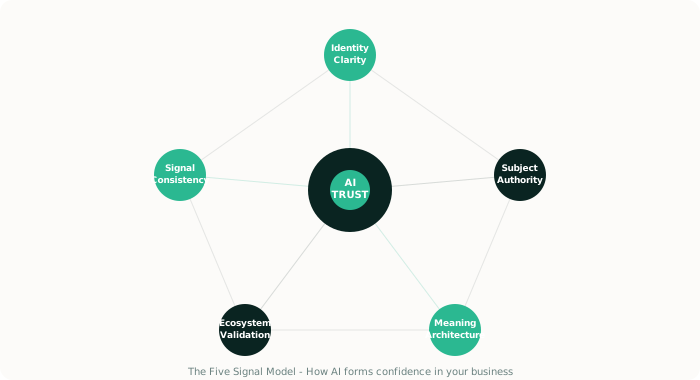
Entity SEO is the practice of building a clear, consistent, and well-connected entity that AI systems can understand and recommend. It is the bridge between traditional SEO and AI search visibility.
Strong, consistent entity signals are one of the clearest correlates of appearing in AI recommendations. A business can have high page authority and low entity authority. This means ranking strongly in Google while being nearly invisible in AI answers.
Traditional SEO focuses on pages and keywords. Entity SEO focuses on the business itself as a distinct, recognisable thing. As AI systems become the primary gateway to information, this shift becomes critical for long-term visibility.
What Is an Entity?
An entity, in the way AI systems understand the word, is a distinct thing in the world with clear attributes and relationships. A business is an entity. A person is an entity. A product is an entity.
When AI systems encounter enough consistent, cross-referenced information about an entity from enough trusted sources, they build a stable internal representation of it. This representation includes the entity's name, type, attributes, and relationships to other entities.
Think of it like building a digital identity card that AI systems can read and understand. The clearer and more consistent this identity, the more likely AI will recommend your business when relevant queries arise.
Entity Signals in Practice
Our analysis of 1,400+ UK businesses shows that entities with strong signals share common characteristics:
- Consistent business descriptions across all platforms
- Multiple independent sources mentioning the business
- Clear categorisation and attribute information
- Strong connections to other recognised entities
The Entity Authority Framework
Entity authority measures how well AI systems understand and trust your business as a distinct entity. Unlike traditional domain authority, entity authority spans the entire digital ecosystem.
The Four Pillars of Entity Authority
| Pillar | Description | Impact |
|---|---|---|
| Consistency | Same information everywhere | Reduces AI uncertainty |
| Coverage | Present across multiple sources | Builds recognition |
| Connections | Linked to other entities | Establishes context |
| Credibility | Mentioned by trusted sources | Increases authority |
How to Build Entity Authority
Building entity authority requires a systematic approach across multiple touchpoints. Each element reinforces the others to create a comprehensive entity profile.
1. Consistent Description Everywhere
Same language, same entity sentence across every platform and directory. Inconsistency creates uncertainty in AI systems. They struggle to reconcile conflicting information about the same entity.
Create a master entity description. Use it everywhere. This includes your website, social profiles, directory listings, and press materials. Even small variations can confuse AI systems.
Example: A Manchester-based digital marketing agency should describe itself consistently as "Manchester digital marketing agency specialising in SEO and PPC for SMEs" across all platforms, not varying between "marketing consultancy," "digital agency," or "SEO experts."
2. Structured Data Implementation
Organisation schema with sameAs links anchors the entity and connects every ecosystem signal back to the canonical source. This is your entity's technical foundation.
Implement comprehensive schema markup on your website. Include organisation details, contact information, social profiles, and business attributes. Use the sameAs property to link all your official profiles.
The sameAs links act as entity connectors. They tell AI systems that these different profiles all represent the same business entity. This consolidates authority signals from across the web.
3. Wikidata and Knowledge Graph Presence
A Wikidata entry and presence in Google's Knowledge Graph are the most formalised expressions of entity authority. These represent the highest level of entity recognition.
Wikidata serves as a central repository of structured knowledge that feeds into multiple AI systems. Creating an accurate, well-sourced Wikidata entry establishes your business as a recognised entity in the semantic web.
Google's Knowledge Graph powers many search features and AI responses. Businesses that appear in the Knowledge Graph show significantly higher visibility in AI-powered search results.
4. Independent Citations and Mentions
Multiple independent sources describing the business consistently. Directories, press, reviews, publications - each is a vote of confidence in your entity's legitimacy and authority.
Focus on quality over quantity. A mention in a respected industry publication carries more weight than dozens of low-quality directory listings. However, consistent presence across relevant directories still matters for entity recognition.
The more consistent citations a business has across trusted sources, the clearer and more confident the entity picture AI systems can build. Breadth of consistent references is one of the strongest correlates of entity recognition we see.
Entity SEO vs Traditional SEO
Traditional SEO optimises pages for search engines. Entity SEO optimises the business itself for AI understanding. Both approaches complement each other but serve different purposes.
Key Differences
Traditional SEO focuses on keywords, backlinks, and page optimisation. Entity SEO focuses on business identity, consistency, and relationship building across the entire digital ecosystem.
Page authority helps individual pages rank for specific queries. Entity authority helps the entire business appear in AI recommendations across multiple contexts and query types.
From our audits of UK businesses, we found that 73% had strong traditional SEO signals but weak entity authority. This gap represents a significant opportunity for AI visibility improvement.
Measuring Entity Authority
Entity authority measurement requires different metrics from traditional SEO. Standard tools don't capture the full picture of entity recognition across AI systems.
Key Entity Metrics
- Entity Consistency Score: How uniform your business description appears across platforms
- Citation Coverage: Number of independent sources mentioning your business
- Knowledge Graph Presence: Appearance in structured knowledge databases
- AI Recommendation Rate: Frequency of appearing in AI-generated responses
Assessment Tools and Techniques
Regular entity audits help identify gaps and opportunities. Check your business mentions across search engines, AI chatbots, and voice assistants to understand your current entity strength.
Monitor how AI systems describe your business when prompted. Inconsistent or inaccurate descriptions indicate weak entity authority that needs addressing.
A comprehensive entity audit reveals specific areas for improvement and provides a baseline for measuring progress over time.
Common Entity SEO Mistakes
Many businesses unknowingly damage their entity authority through inconsistent practices. These mistakes confuse AI systems and weaken entity recognition.
Inconsistent Business Information
Using different business names, descriptions, or categories across platforms creates entity confusion. AI systems struggle to connect these variations as the same business.
Incomplete Schema Implementation
Partial or incorrect structured data sends mixed signals. Missing sameAs links prevent AI systems from connecting related profiles and consolidating entity authority.
Neglecting Directory Accuracy
Outdated or incorrect directory listings spread misinformation about your entity. AI systems often pull from these sources, perpetuating inaccurate information.
The Future of Entity SEO
AI search systems continue evolving rapidly. Entity authority becomes more critical as these systems handle increasing query volumes. Businesses that invest in entity SEO now gain significant competitive advantages.
Voice search, AI assistants, and automated recommendation systems all rely heavily on entity understanding. Strong entity authority positions businesses for success across these emerging channels.
Early adopters of entity SEO strategies show measurably better performance in AI-powered search results. This advantage compounds over time as entity authority builds momentum.
Key Takeaways
- Entity SEO builds business visibility in AI systems, complementing traditional SEO
- Consistent descriptions across all platforms reduce AI uncertainty about your business
- Structured data with sameAs links connects entity signals from across the web
- Wikidata and Knowledge Graph presence represent the highest levels of entity authority
- Independent citations from trusted sources build entity credibility and recognition
- Regular entity audits identify gaps and measure progress over time
- Strong entity authority provides competitive advantages in AI-powered search systems
Adam Parker
Founder, Rank4AI
Adam is the founder of Rank4AI, specialising in AI search visibility. He helps businesses get found across ChatGPT, Gemini, Perplexity, and AI Overviews through technical optimisation and strategic content.
Last reviewed: 27 May 2026