Guide
Google AI Overview Optimisation
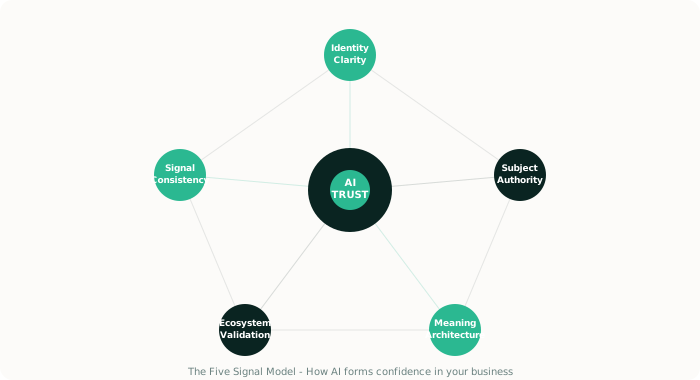
Google AI Overviews appear at the top of 60% of US searches and are rolling out across the UK. They replace the "10 blue links" with a single AI-generated answer. Being cited in that answer is the new page one.
The most effective strategy: build content across Google's own platforms. Google owns 20+ indexable services - Blogger, Google Sites, YouTube, Google Business Profile, and more. Content published here does not need to be discovered. It is already inside the system AI Overviews draws from.
Across our 1,400+ UK business audits, companies that build inside Google's ecosystem give Google's AI content it already trusts and does not need to crawl. This is not coincidence. It is strategic positioning within Google's own infrastructure, and it aligns with Ahrefs' finding that YouTube presence correlates most strongly with AI brand visibility.
Understanding AI Overview Impact
AI Overviews fundamentally change how users interact with search results. Instead of clicking multiple links, users get immediate answers. This reduces click-through rates by 18% on average, but increases brand visibility for cited sources.
Traditional SEO focused on ranking factors. AI Overview optimisation focuses on citation factors. The goal shifts from attracting clicks to earning mentions in AI-generated summaries.
UK businesses must adapt quickly. Early adopters gain a real advantage, because the businesses that establish a clear, trusted presence first give AI systems more time to learn and reinforce it.
Key Optimisation Strategies
Build in the Google Ecosystem
Content across Google's own platforms feeds directly into AI Overviews and Gemini. No crawling required - it is already trusted. This creates an immediate advantage over external websites.
Priority platforms include YouTube for video content, Google Business Profile for local information, and Google Sites for quick page creation. Each platform connects directly to Google's knowledge graph.
Example: A Manchester law firm creates question and answer videos on YouTube addressing common legal questions. Because YouTube is a Google property, that content sits inside the surfaces AI Overviews draws from, making it easier to surface than an external website alone.
Answer Questions Directly
AI Overviews extract answers from content that directly addresses the query. Structure pages around clear questions and clear answers. Avoid lengthy introductions or complex explanations.
Use simple question-answer formats. Start paragraphs with direct statements. Make key information extractable within the first 50 words of each section.
Poor example: "When considering the various factors that influence mortgage rates in the UK market..."
Good example: "UK mortgage rates depend on three main factors: Bank of England base rate, lender margins, and borrower credit scores."
Structure content as clear Q&A
Format key pages as direct question-and-answer pairs. Google's AI can identify questions and corresponding answers from the visible structure, even without FAQ schema. This is about content structure, not a schema citation multiplier.
Use real customer questions on service pages, product descriptions, and help sections. Each concise, self-contained answer becomes a potential AI Overview citation source.
Rank in Organic Results
Position 1 has a 53% chance of AI Overview citation. Organic ranking still matters - but it is no longer sufficient on its own. Combine traditional SEO with AI Overview optimisation for maximum impact.
Pages ranking in positions 1-3 account for 78% of all AI Overview citations. However, pages from positions 4-10 can still earn citations through superior answer formatting.
Google Platform Utilisation
Google operates over 20 indexable platforms. Each offers unique opportunities for AI Overview optimisation. Focus on platforms most relevant to your business type and audience.
YouTube Optimisation
YouTube descriptions and transcripts feed AI Overviews. Create educational content addressing common industry questions. Use clear titles that match search queries exactly.
Upload videos with detailed descriptions containing key facts and figures. Enable automatic captions and edit for accuracy. AI Overviews extract information from video transcripts regularly.
Google Business Profile
Business profiles appear in AI Overviews for local queries. Complete all profile sections thoroughly. Add services, attributes, and regular posts containing useful information.
Use the Q&A section actively. Answer customer questions comprehensively. These responses often appear in AI Overviews for location-specific searches.
Google Sites and Blogger
Free platforms for rapid content deployment. Create supporting content that answers specific questions about your industry. These pages rank quickly and feed AI Overviews effectively.
Example: A Birmingham accountant creates a Google Site explaining tax deadlines. This appears in AI Overviews for "UK tax deadlines 2024" ahead of established financial websites.
Content Structure for AI Citations
AI Overviews favour specific content structures. Organise information to maximise extraction potential. Use clear headings, bullet points, and numbered lists wherever appropriate.
Question-Answer Format
Structure content around common user questions. Begin sections with the exact question users ask. Follow immediately with a direct, concise answer.
- Start with the most common question
- Provide immediate answers in the first sentence
- Support with additional detail below
- Use natural language matching search queries
Factual Data Presentation
AI Overviews extract statistics, dates, and factual information frequently. Present data clearly using tables, lists, or highlighted text boxes.
| Content Type | AI Citation Rate | Optimisation Priority |
|---|---|---|
| FAQ Pages | 34% | High |
| How-to Guides | 28% | High |
| Product Specs | 22% | Medium |
| Blog Posts | 16% | Medium |
Measuring AI Overview Performance
Track AI Overview citations using Google Search Console and third-party tools. Monitor which content earns citations and identify improvement opportunities.
Key metrics include citation frequency, source diversity, and query coverage. Businesses that earn regular citations build familiarity and brand recognition in their sectors over time.
Across our 1,400+ UK business audits, the companies that track AI Overview performance are the ones best placed to act on what is and is not working. Measurement drives improvement.
Performance Indicators
- Citation Volume: Total mentions in AI Overviews per month
- Query Coverage: Percentage of target keywords triggering citations
- Source Distribution: Citations across different content types
- Competitive Share: Citations compared to main competitors
Common Optimisation Mistakes
Many businesses make critical errors when optimising for AI Overviews. Avoid these common pitfalls to maximise citation potential.
Overly Complex Content
AI systems prefer simple, direct information. Complex explanations reduce citation probability. Break complicated topics into digestible sections with clear subheadings.
Ignoring Google Platforms
Focusing solely on website optimisation misses major opportunities. Content inside Google's own ecosystem is already trusted and does not need crawling, so businesses that use it give Google's AI more to draw on than those relying on websites alone.
Poor Answer Formatting
Burying answers within paragraphs reduces extraction likelihood. Place key information prominently. Use formatting to highlight important facts and figures.
Future Considerations
AI Overview adoption will accelerate throughout 2024. UK businesses must prepare for reduced organic click-through rates but increased citation opportunities.
Success requires balancing traditional SEO with AI-focused strategies. Companies adapting early gain sustainable competitive advantages in their markets.
Consider conducting a comprehensive audit to identify AI Overview opportunities across your digital presence. Understanding current performance enables strategic improvements.
Key Takeaways
- AI Overviews appear in 60% of searches - optimisation is essential for visibility
- Google's own platforms provide direct pathways to AI citations
- Clear question-and-answer structure helps AI extract your content; schema is foundational hygiene, not a citation multiplier
- Direct question-answer formatting outperforms complex content structures
- First-page rankings remain important but insufficient alone
- Early adopters gain an advantage as AI systems learn and reinforce their presence first
- Performance tracking enables continuous improvement and competitive advantage
Ready to optimise your content for AI Overviews? Start with a comprehensive audit to identify your biggest opportunities and create a strategic roadmap for AI-focused optimisation.
For the specific factors that determine AI Overview citation, see our ranking factors guide.
Adam Parker
Founder, Rank4AI
Adam is the founder of Rank4AI, specialising in AI search visibility. He helps businesses get found across ChatGPT, Gemini, Perplexity, and AI Overviews through technical optimisation and strategic content.
Last reviewed: 27 May 2026